Skylight and rooflight installers in Stockport

Skylight and rooflight installation and replacement in Stockport

Skylights and rooflights fitted new or replaced across Stockport, with the controls, blinds and cleaning walked through at handover.

Takes you to the survey form on this page and adds your postcode to any WhatsApp message.

  • Fixed written quote
  • We handle the Building Regulations notification where the work is notifiable
  • 10-year workmanship guarantee
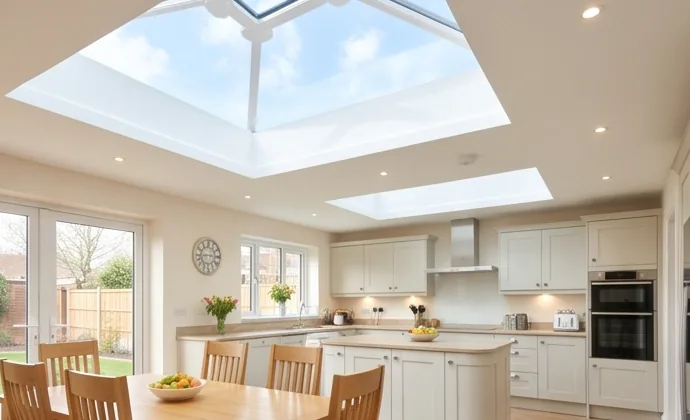
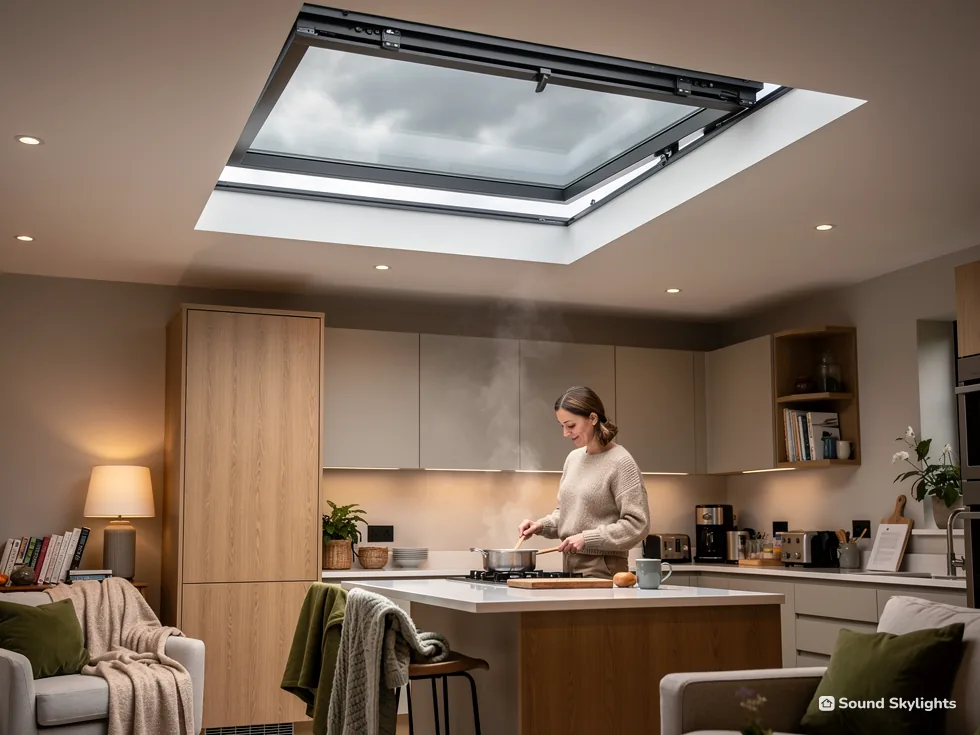
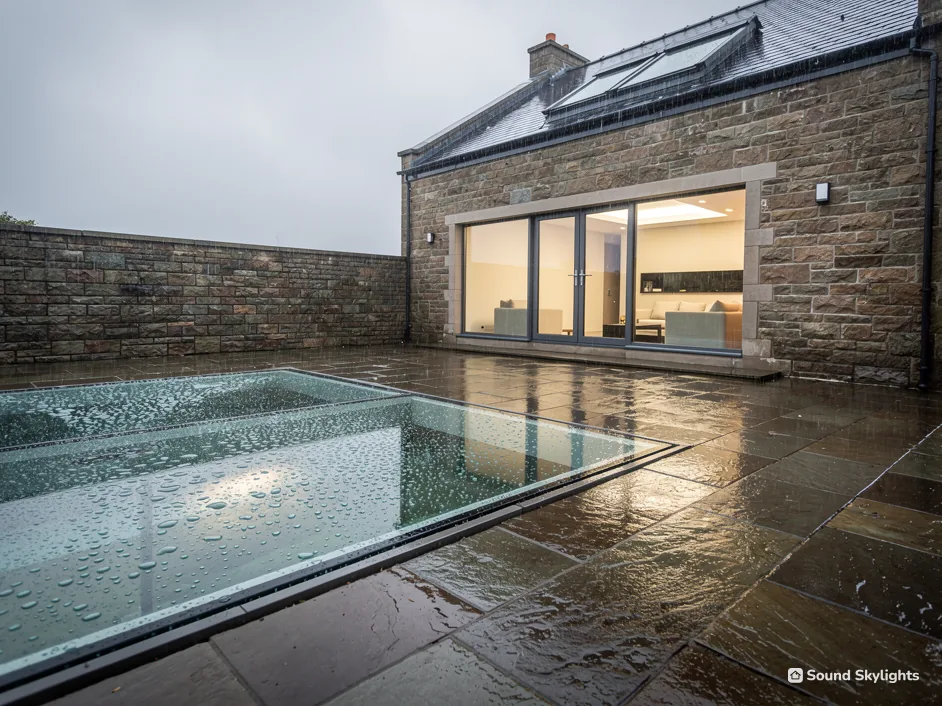
A kitchen-diner under a large roof lantern, with a second flat rooflight over the kitchen units and French doors to the garden
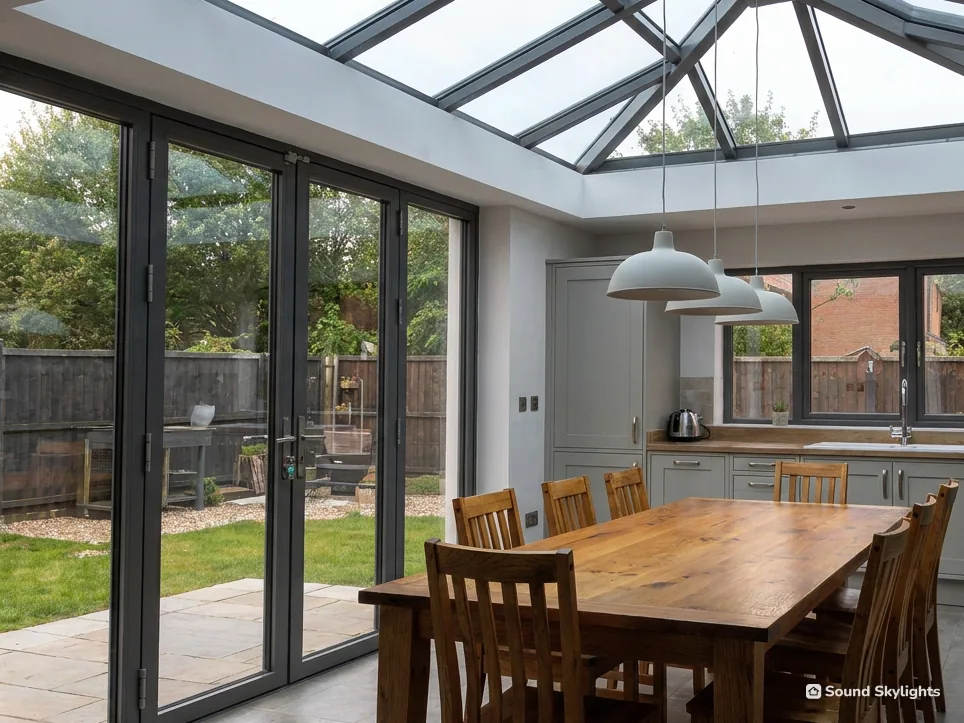
Roof lantern over a kitchen extension

Skylights and rooflights we fit and replace

From a VELUX roof window in a loft to a lantern over a kitchen extension, each one fitted new or swapped for the one you have now.

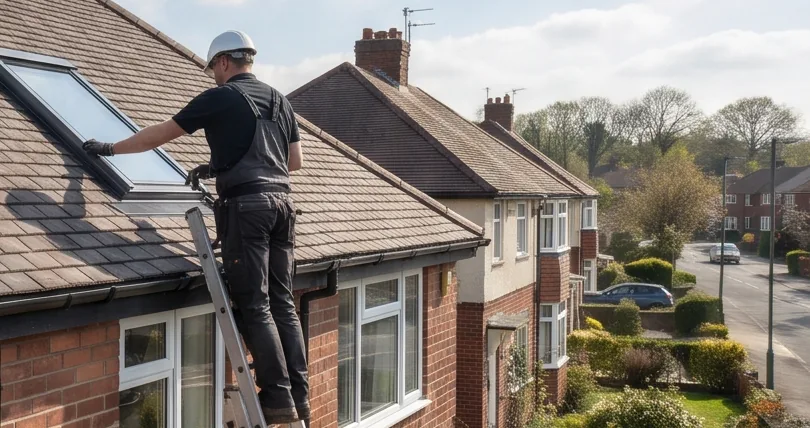
A fitter on a ladder working at a roof window in the tiled roof of a brick semi-detached house

Easy to live with

A rooflight gets opened, shaded and cleaned for years, so we explain yours before we leave.

  • How it opens: by hand, with a control rod or by remote, picked for the height of your ceiling.
  • Which blinds suit the room, from blackout in a bedroom to a pleated blind in a kitchen.
  • How the outside glass gets cleaned, on a pitched roof, a flat roof or a lantern.
  • Whether your model has a rain sensor. Some makers build one into some of their electric and solar roof windows.

Your survey, step by step

  1. A free survey at your house

    At the house we check the roof, the room beneath it and how it will be used, then measure up.

  2. A fixed written quote

    The price follows the survey as a fixed written quote, never from a photo alone.

  3. Fitted, then explained

    Once it is fitted, we demonstrate how it opens, which blinds are available and how to wash the glass outside.

Book a free survey

Areas covered: Stockport and 30 road miles around

About 30 road miles around Stockport

The circle shows 30 miles as the crow flies. We measure our limit by road, so a few places near the edge sit just outside it.

Do we cover you?

We fit and replace skylights and rooflights within about 30 road miles of Stockport town centre, which takes in most of Greater Manchester, much of Cheshire, the High Peak and the Pennine towns just over the hills in West Yorkshire.

Takes you to the survey form on this page and adds your postcode to any WhatsApp message.

Towns we cover

Short answers on cost, planning and upkeep

Do I need planning permission to put a skylight in my roof?

For a house in England, usually not. Adding a rooflight or roof window is normally permitted development, as long as it stays within limits on how far it sticks out, how high it sits and, on a side-facing slope, what kind of glass it has and whether it opens. Flats and homes where the rights have been taken away are different, and so is a listed house, which keeps them but needs listed building consent for changes that affect its character. The full list is in the planning answer further down.

How much does it cost to fit a new skylight?

We do not give figures from a photo, as the roof, the access and the finish inside change the job as much as the window itself does. The free survey sets out what your job involves, and you get a fixed written quote for it. Our costs page explains what moves the price.

How do I find my VELUX window size or model code?

Open the window and look for the data plate. VELUX puts it at the top of the window frame, where you can see it once the sash is open. The size part of the code, such as MK04, gives the width as the letter and the height as the digits; MK04 is 78 cm wide and 98 cm high. A photo of the plate sent by WhatsApp to 07880 284133 is a useful start before the survey.

Is it a leak or just condensation?

Droplets on the room side of the glass on a cold morning, often in a bathroom or over a kitchen, are condensation from moist air in the room meeting cold glass. Mist trapped between the panes means the seal of the glazed unit has gone, and no amount of wiping will clear it. Water running down the lining from around the frame is neither of those, and the survey looks at whether a replacement with new flashings is the answer.

What is a cheaper alternative to VELUX?

VELUX is the name most people know, but it is one of several brands. Keylite and Fakro, among others, make roof windows in similar sizes, each with its own flashings, blinds and electric options. Prices differ from one maker and range to the next, so it pays to compare like with like, and the survey looks at which one suits how the room will be used.

What are the standard sizes for rooflights?

There is no single standard. Each roof window maker has its own set of sizes and its own size codes. Flat roof rooflights and roof lanterns come in stock sizes too, but plenty are made to measure so they fit the kerb, the upstand or the room below. The survey measures what you have and what the room can take.

Do you fit conservation rooflights?

Yes. Conservation rooflights sit low in the roof on slim frames, often with a vertical glazing bar in the manner of old cast-iron rooflights, and they can suit slate roofs on Victorian and older houses. A listed house needs listed building consent before work that changes its character. See our conservation rooflights page.

Can a roof window be replaced without scaffolding?

It depends on the window, the pitch and the height of the roof. A like-for-like roof window change can sometimes be done from inside the room, working through the opening. A steep or high roof, a large flat rooflight or a lantern can need a tower or scaffold. The survey shows which applies before any price is given, and skylight replacement without scaffolding has its own answer.

Before you commission the work

Skylight and rooflight installation in Stockport: the questions worth asking

Light, products, the work itself, the rules and the price, for houses from Edgeley to Marple.

A rooflight stays part of the room for years, so the useful questions carry on past the day the glass goes in. Whether the job is skylight installation in a loft, rooflight installation over an extension or skylight replacement on a tired old unit, the product, the work, the rules, the price and daily life with it all come into the answers.

They are written for the houses in and around Stockport, which include many Victorian terraces in Edgeley, Heaton Norris and Reddish, big villas in the Heatons and Davenport, interwar and post-war semis and bungalows in Bramhall, Cheadle Hulme and Hazel Grove, and stone houses in Marple and Romiley.

What will more natural light do for a dark room?

Start with the room you avoid. In Stockport houses it is not hard to find: the back bedroom of a Victorian terrace whose only window faces the next house's wall, the landing of an interwar semi lit by whatever creeps out of the bathroom, the kitchen at the end of an extension whose old back window now looks into the new room instead of the garden.

Light from above behaves differently from light through a wall. A wall window lights the strip of floor nearest to it and fades towards the back of the room, while glass in the roof faces open sky rather than the house over the road, so its daylight reaches further and spreads more evenly.

Brightness and wellbeing

A loft that held boxes becomes somewhere to sit and read, and a long kitchen extension stops feeling like a corridor to the garden. A bright room on a grey Stockport morning is a better place to start the day.

Where on the roof

On a pitched roof, a roof window set low on the slope lets you see out while standing; set higher, it lights the room but shows mostly sky. Over a stair, one rooflight can brighten two floors. In a flat-roofed extension, a lantern or flat roof rooflight over the middle of the room spreads the light wider than one tucked against a wall. The free survey happens in the room itself for this reason: position fixes which control is needed.

Skylight and rooflight words

Skylight
The everyday word for glazing in a roof. In the trade the same thing is usually called a rooflight.
Rooflight
Approved Document L describes it as glazing set out of plane with the roof on a kerb or upstand, and notes it is also sometimes called a skylight.
Roof window
A window fitted in the same plane as the roof slope, such as a VELUX window in a slate or tiled roof.
Roof lantern
A raised glazed roof on a flat roof, often on aluminium frames. By Approved Document L's definition it counts as a rooflight.
Sun tunnel
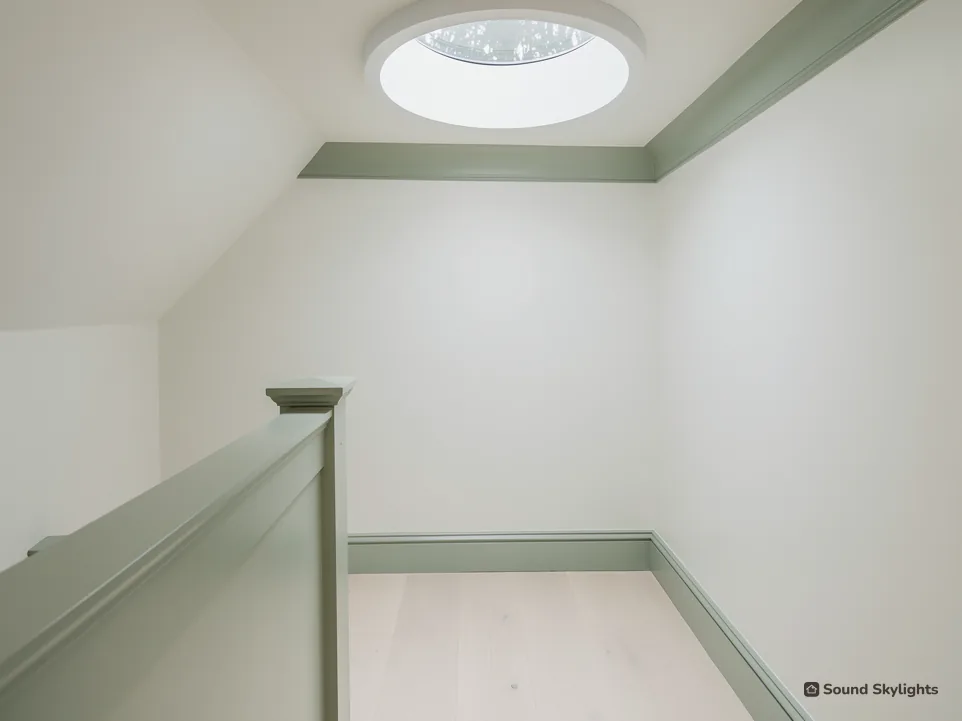
A light tube: a roof dome with a reflective tube running down to a diffuser in the ceiling, for a landing, hall or bathroom with loft space above.
Roof window, flat roof rooflight, lantern or sun tunnel: which suits my house?

Pitched roofs

On a slate or tiled slope the usual answer is a roof window. VELUX is the best-known name, and Keylite and Fakro also make roof windows in a range of standard sizes, each range with flashing kits matched to the roof covering. A centre-pivot window turns on hinges at its sides, about halfway up, while a top-hung window is hinged at the top and opens outwards. The guide to choosing how a roof window opens sets the two side by side.

Flat roofs and sun tunnels

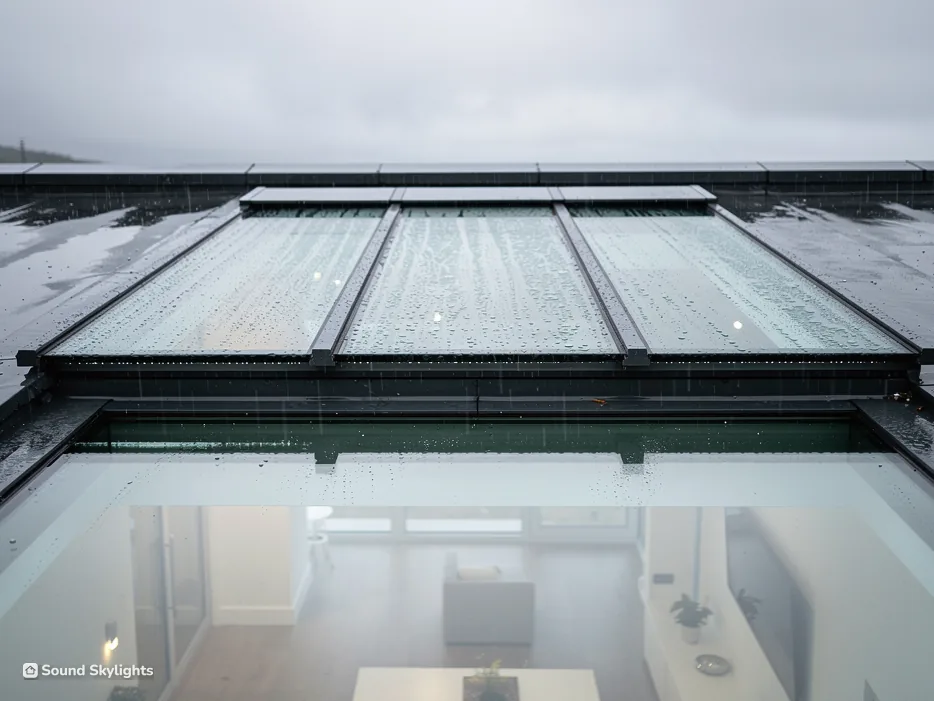
On a flat roof over a single-storey extension, a dormer or a garage turned into a room, the choice is between a flat roof rooflight and a roof lantern. A rooflight on a flat roof is low-profile, set on a kerb or upstand, and frameless designs can look like one sheet of glass from inside; a lantern rises under a pitched glass top, often on aluminium frames, and makes a feature of the middle of a kitchen or dining room. Both are often bespoke, made to measure so the size follows the room. A sun tunnel suits a landing, a windowless bathroom or a hall beneath loft space: a clear dome on the roof gathers the light and a reflective tube takes it down to a round diffuser in the ceiling, so it gives daylight rather than a view and has no sash to open.

Beyond the five main products

The full list of what we fit: roof windows, VELUX windows, flat roof rooflights, roof lanterns and sun tunnels.

Which product for which roof
ProductRoofHow it opens
Roof windowPitched slate or tileBy hand, control rod, electric or solar
Flat roof rooflightFlat roof, on a kerb or upstandFixed, hinged or electric, by model
Roof lanternFlat roof, often an extensionUsually fixed; some models have opening vents
Sun tunnelPitched or flat, with loft space belowNo opening sash

How does skylight installation work, from survey to finished ceiling?

A new opening in a pitched roof runs in the order below. Flat roofs and lanterns change the middle steps, and adding a roof lantern to an existing roof has a guide of its own.

  1. Free survey. We look at the roof covering, the rafters or joists, the room below and how it will be used, then measure up and check whether planning permission or the Building Regulations come into it. A fixed written quote follows.
  2. Opening the roof. The slates or tiles over the position are lifted and the felt or membrane cut back, and where a rafter has to go the opening is trimmed with new timbers above and below. The rafters either side may be strengthened so the roof carries its load around the hole, and this structural work is one reason a new rooflight will generally need Building Regulations approval.
  3. Flashing and covering. The flashing kit keeps the roof watertight around the frame, and makers sell kits shaped for different coverings, from low-profile ones for thin flat slate to deeper ones for profiled concrete tiles. The slates or tiles are cut and refixed around it.
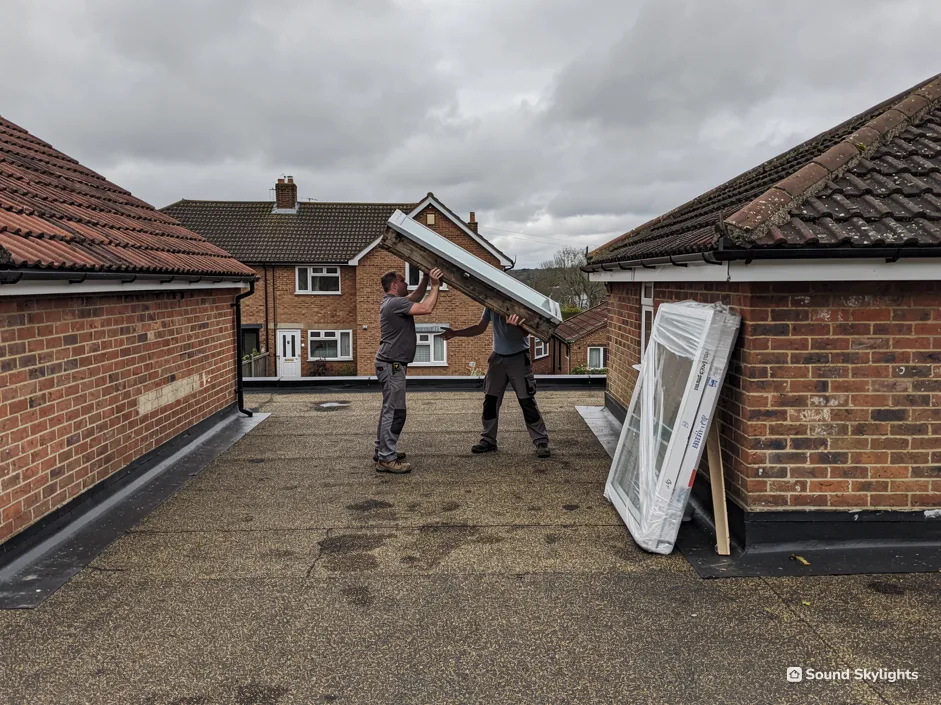
  4. Kerb on a flat roof. On a flat roof the rooflight or lantern stands on a kerb or upstand, either supplied with the unit or built on site, with the roof covering taken up its sides so water runs off. A lantern's weight has to be carried by the roof structure, which the survey checks.
  5. Lining inside. The lining around the opening is formed and insulated, then boarded and plastered, and linings that splay out into the room spread daylight further than square ones. Plaster needs time to dry before decorating.
  6. Handover. The window is shown working, controls and all, with an explanation of the blinds on offer and of the way the outer glass gets washed.

Which flashing suits slate and which suits tile is covered in the answer on roof window flashing.

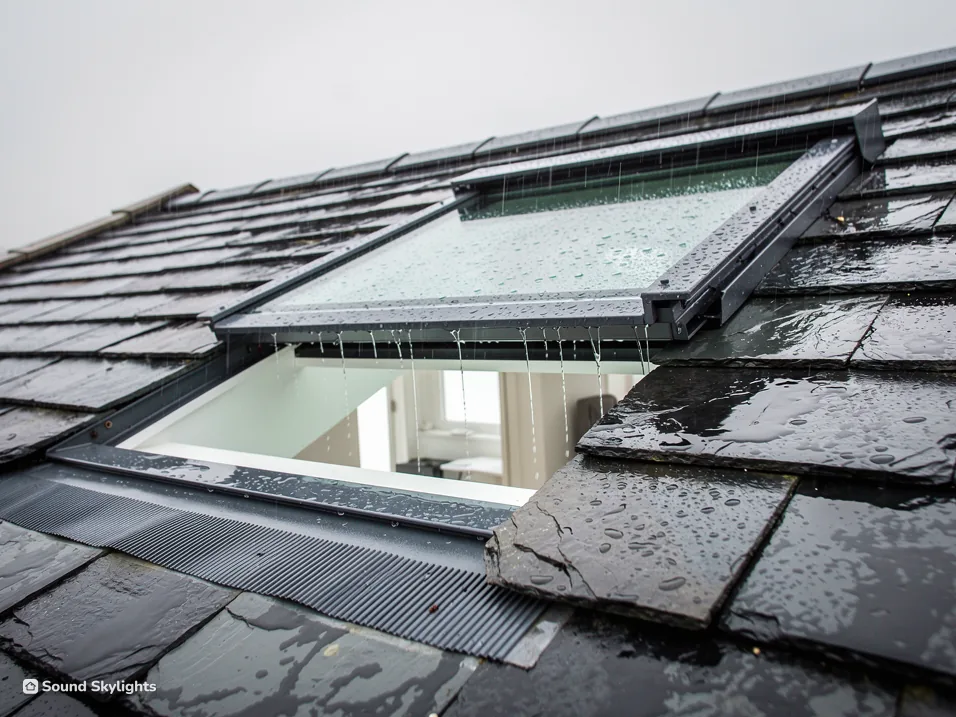
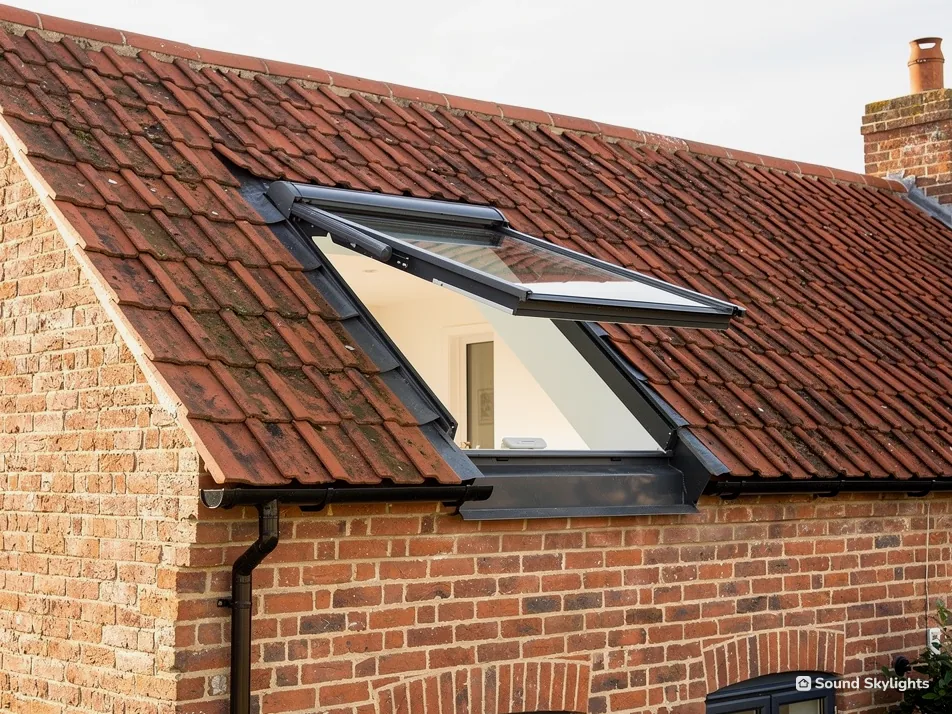
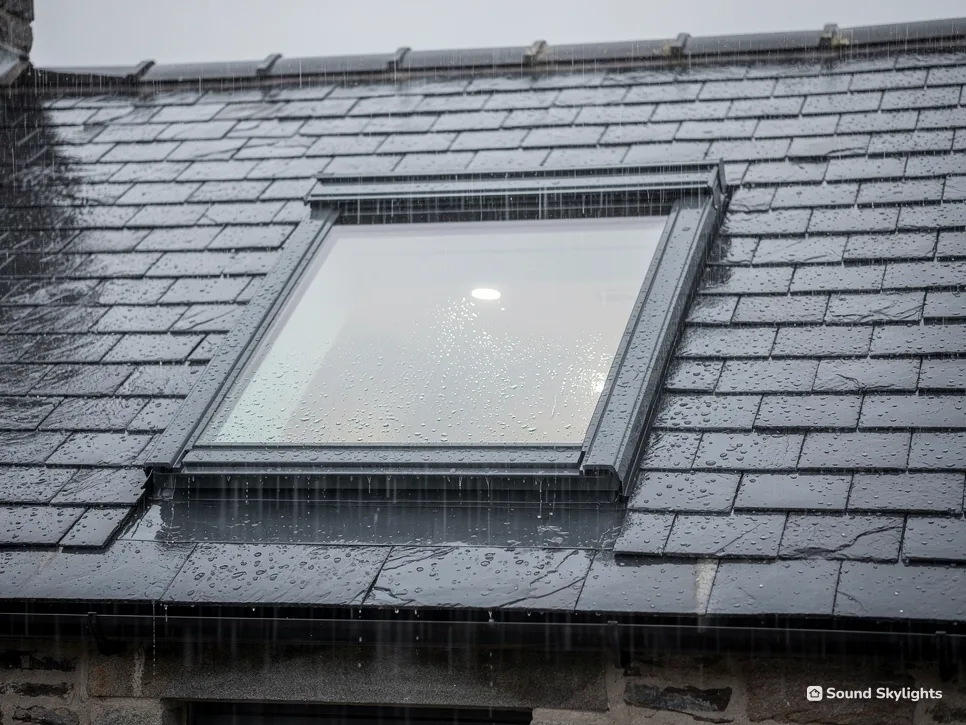
From outsideA roof window set into a wet slate roof, close up
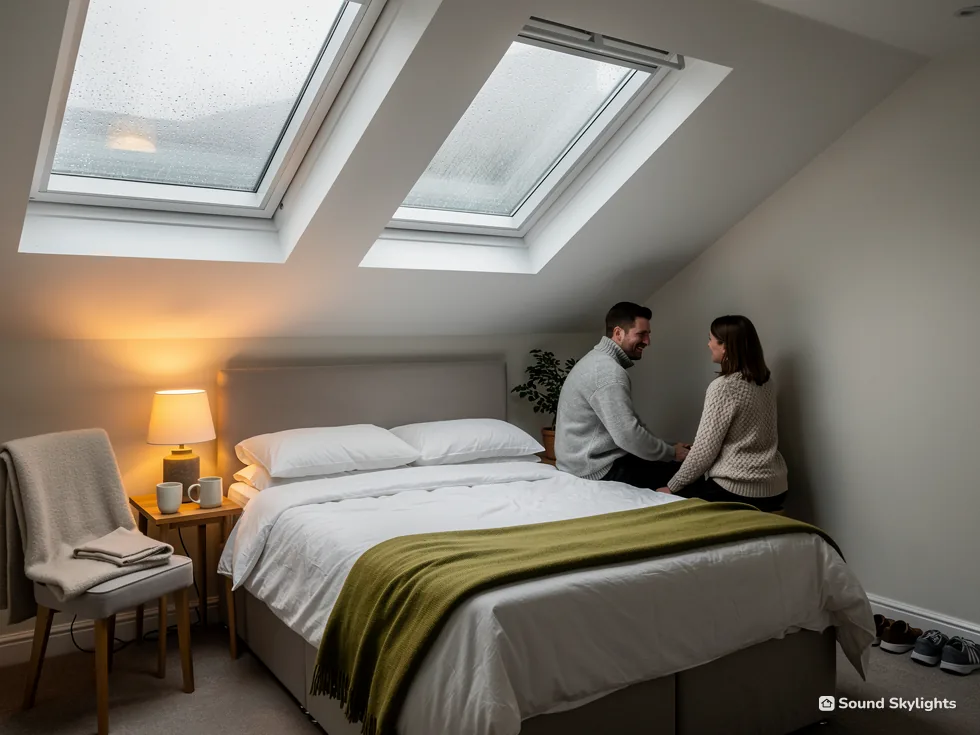
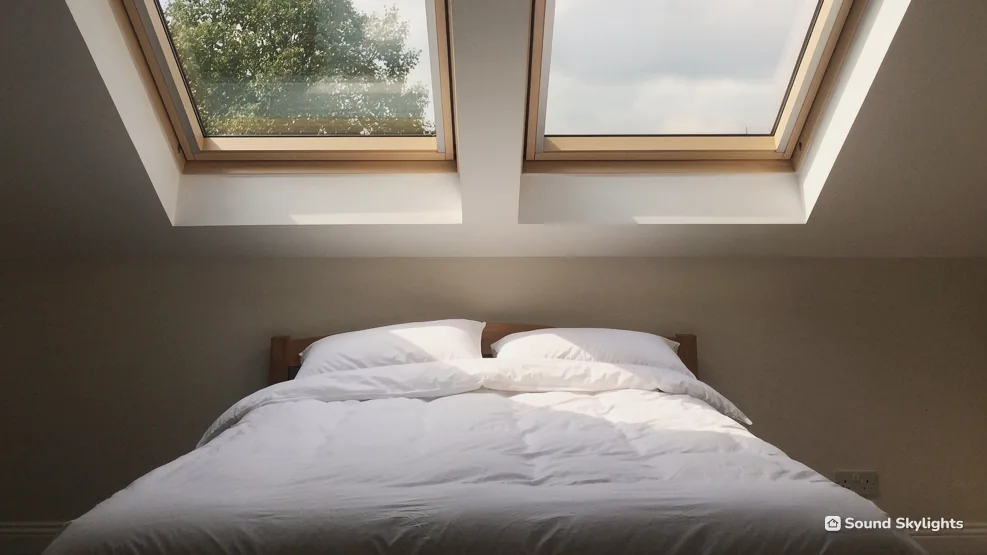
From insideA loft bedroom with two timber roof windows above the bed, trees seen through the glass
Two different roof windows: one seen from the roof, one from a loft bedroom.

Is replacing an old rooflight or VELUX window a straight swap?

Signs it is time for a replacement

Mist between panes
The seal of the glazed unit has failed
Water on the room side
Usually condensation from damp room air
Stiff or out of reach
A new control, electric or solar model
Cloudy plastic dome
A glass rooflight, sometimes on a new kerb
Same size code
Made to fit the existing opening

Water coming in around the frame is a question for the survey, which looks at the flashing as well as the window.

Why people replace

Misting between the panes is the usual giveaway: the seal of the glazed unit has failed, so the mist sits where no cloth can reach. Others replace a window that is stiff, hard to reach or draughty, or a cloudy plastic dome on a flat roof, and some simply want a remote control where a pole used to be. Droplets on the room side of the glass are a different matter, since warm, damp air from a bathroom or kitchen meets cold glass and turns to water, as on a car windscreen. Opening the window or using the vent position often helps more than new glass would.

When it is not a straight swap

A new window with the same size code is made for the opening already there, so the existing lining and plaster can be left; another maker means checking the sizes line up, because the codes are not shared. Going bigger needs new trimming in the roof and new lining and plaster inside, so the job starts to look like a new opening. A change from manual to electric may need a power supply to the window, which a solar model avoids.

The rules for a replacement

For a replacement, these points apply:

  • In England, a new or replacement roof window in an existing home should have a U-value no worse than 1.4 W/m²K, or a Window Energy Rating of Band B or better.
  • Should the new unit be a rooflight, its U-value should come in no higher than 2.2 W/m²K, which is the figure for rooflights.
  • A replacement element should also be no worse than the one it replaces.
  • Ventilation is checked at the survey.
  • Where a new house would need an escape window in that position and the existing window is big enough for escape, the replacement should give at least the same escape potential, though a window larger than needed can be reduced to the minimum escape size.
  • Replacing only the glass, or a window in its existing frame, is not providing a controlled fitting, so the energy limits do not apply to that work.
  • Table 4.2 of Approved Document L is the source of the energy figures.

How will I open it if the ceiling is out of reach?

Within reach and just out of reach

On a centre-pivot roof window the handle runs along the top of the sash, so a window set low on a loft slope is opened by taking hold of the bar and pulling it towards you. VELUX centre-pivot windows also have a ventilation flap in that handle bar, which lets the room be ventilated with the sash shut. A control rod hooks into the handle so the window can be worked from the floor; it is simple and has nothing to go flat, but it needs somewhere to live, such as a hook on the wall, and a rod put away in another room means a window that stops being opened.

Well out of reach

Over a stairwell, under a high vaulted ceiling or in a lantern, electric opening makes sense. An electric window needs a mains supply, and you open it from a wall switch or with a remote control. A solar model charges its battery from a small panel on the window, so no cable has to reach it through the ceiling. For the choice between electric and solar, see electric or solar opening rooflights.

Rain sensors

VELUX describes its INTEGRA electric and solar roof windows as having a sensor for rain, which closes the window automatically when rain is detected. Other makers have their own versions on some electric models, so it is a point to check product by product. A manual window has nothing of the kind, so closing it in a downpour is down to you; rain sensors on opening rooflights has the detail.

Children, older relatives and the controls

In a child's bedroom a remote can be kept out of reach and a wall switch can sit higher than a small hand, and some makers offer child-safe locks or restrictors for manual roof windows. Where a roof window is also the escape window for the room, Approved Document B allows it to have locks and opening stays with child-resistant release catches, and it should be able to stay open without being held. For an older relative, a wall switch by the door is often easier than a rod.

Ways to open a roof window
ControlSuitsDay to day
HandleWithin easy reachReach up and push
Control rodJust out of reachHook on, push, hang it back up
ElectricHigh ceilings, over stairsWall switch or remote; needs a power supply
SolarReplacements, finished ceilingsRemote; a small panel charges the battery

Which blind suits, and how is the outside glass kept clean?

Blinds by room

  • Bedroom: a blackout blind, because June mornings start early and a roof window lets in a lot of sky.
  • Kitchen or home office: a pleated or roller blind that softens the light without shutting it out.
  • Bathroom: a blind built for a damp room.

VELUX also sells external awning blinds that sit outside the glass and, the maker says, cut heat before it reaches the room. Makers design their blinds for their own window sizes, so a blind is bought for the size code, and on VELUX windows it clips into brackets on the frame. The VELUX blinds and controls guide goes room by room.

Cleaning a pitched roof window

On a centre-pivot roof window the sash turns right round so the outside glass faces into the room and can be held there while you clean it from inside, and many top-hung models also have a cleaning position.

Cleaning flat rooflights and lanterns

Glass on a flat roof is cleaned from outside: a water-fed pole from the garden usually reaches a single-storey extension, and otherwise it is a short ladder. Some makers offer glass with a self-cleaning coating that, they say, uses daylight and rain to loosen dirt, which cuts down the work without doing away with it. A lantern's ridge and glazing bars collect leaves if there are trees nearby. Only a walk-on rooflight is designed to be stood on, so a ladder and a pole are the way to reach the rest.

Blind and window together

A manual blind on a high window needs the same control rod as the window, while an electric or solar blind pairs with an electric or solar window.

Do I need planning permission or Building Regulations approval?

Who to ask

Planning in Stockport
Stockport Metropolitan Borough Council
Inside the Peak District National Park
Peak District National Park Authority
Listed buildings
Listed building consent from the planning authority
Building Regulations
Either a registered building control approver or council building control
Certainty on planning
A Lawful Development Certificate from the planning authority

Planning permission and Class C

In England, adding a rooflight or roof window to a house is usually permitted development under Class C, so it does not need a planning application, provided it meets the Class C limits and conditions. These are the limits and conditions:

  • it must not stick out more than 150 mm beyond the plane of the original roof slope, measured at right angles to the roof surface, and the frame counts;
  • no part of it may be higher than the highest part of the original roof;
  • on a roof slope that forms a side elevation of the house, the whole window must be obscure-glazed, and non-opening unless the parts that open are more than 1.7 m above the floor of the room it is in;
  • the house must not be one that became a home only through a change-of-use permitted development right, such as an office or farm building converted under Part 3, because those houses have no Class C rights.

For a house built before 1 July 1948, original means the roof as it stood on that date. A council can remove permitted development rights in all or part of its area with an Article 4 direction, and rights may also have been removed by a condition on the house's original or a later planning permission. Either way, a planning application is then needed, so we check with the council first. Flats and maisonettes have no householder permitted development rights; Class C applies to houses only. A rooflight on a flat needs planning permission (and usually the freeholder's consent).

Conservation areas, listed buildings and the Peak District

In England a conservation area leaves the Class C right in place; what removes it is an Article 4 direction, or else a restriction written into an earlier permission for the house. Class C has no listed-building exclusion in England, so a listed house still has Class C planning rights, but a new or altered rooflight on a listed building will almost always need listed building consent, and that consent decides the job. Inside the borough of Stockport the planning authority is Stockport Metropolitan Borough Council. National Park status does not by itself take Class C away either. Peak District National Park Authority is the local planning authority inside the park boundary. Outside the boundary, the local council is. If there is any doubt, a Lawful Development Certificate from the planning authority gives formal certainty.

A roof lantern added to an existing flat roof usually stands well over 150 mm proud of the roof, so it normally falls outside Class C and needs planning permission unless the council confirms otherwise. Where the roof is still to be built, the position differs. On a new extension, the lantern is assessed with the extension; we confirm the position with the council before work starts.

Building Regulations

  • A new rooflight will generally need Building Regulations approval: the roof usually has to be cut and the opening trimmed, the roof has to carry the rooflight's weight or be strengthened, the rooflight has to be energy efficient, and near a boundary its fire performance comes into it.
  • Replacing a roof window usually needs Building Regulations approval too, and the replacement answer above has the energy figures.
  • Where the work is notifiable, we handle the Building Regulations notification with the council's building control team or a registered building control approver.
  • A roof window counts as an escape route only on a storey no more than 4.5 m above ground, so a loft conversion on a two-storey house that creates a storey higher than that normally means addressing the full escape route down the stairs, rather than relying on a roof window.
  • The Building Regulations in England set no daylight requirement for houses.

Our guides cover the planning limits in full and the Building Regulations.

What does the price of a new or replacement skylight depend on?

The unit is only part of the bill. The rest is the work around it: what has to be cut, what has to be strengthened, what has to be weathered in outside and finished inside, and how the roof is reached. That is why we survey first, and why you receive a fixed written quote only after the roof covering, the timbers, the room and the access have been seen. Skylight replacement in an existing opening is usually the simpler job to price, because the structure is already there; a new opening, a bigger window or a lantern on a flat roof brings in more of the work in the band below.

Comparing quotes

If you are weighing up more than one quote, line them up on the same points:

  • whether the flashing kit is included;
  • whether the inside lining is insulated, plastered and ready to decorate, or left for you;
  • whether a blind is part of the price;
  • whether the price covers the Building Regulations notification, where the work is notifiable.

Two quotes for the same size window can describe very different jobs. Our costs page goes into each point, with no figures, because a figure without a survey would be a guess.

What moves the price

What changes the price of a rooflight job

Book a free survey

Every price is a fixed written quote after the survey.

  • New opening or replacementCutting and trimming a fresh opening takes more work than swapping a unit in an opening that is already there.
  • Roof and accessSlate or tile, pitched or flat, and how the roof is reached all change the labour.
  • Product and sizeStandard roof window sizes, made-to-measure rooflights and lanterns are priced differently.
  • Glazing and openingEnergy-efficient glazing, electric or solar opening, and rain sensors where the maker offers them.
  • Inside finish and blindsLining, plastering and the blinds you choose.

What does a typical project look like, and what is in writing at the end?

A loft bedroom in a terrace

A pair of roof windows goes into the rear slope of a slate-roofed Victorian terrace to light a loft room. The flashings are the low-profile kind made for slate, the windows sit high on the slope so the control is a rod or a solar motor, and the blinds are blackout because it is a bedroom. A rear slope is not a side elevation, so the side-slope condition does not apply there.

A kitchen extension on a semi

A single-storey extension on the back of an interwar semi gets a roof lantern or a flat roof rooflight over the kitchen table, made to measure for the room. An electric opening model lets steam out without anyone climbing on a worktop, and because the rooflight comes with a new extension, planning is looked at alongside the extension itself.

A replacement on a bungalow

A misted, stiff roof window over a bungalow's back bedroom is changed for a new one with the same size code. The opening and the lining inside stay as they are, and the new window is solar, so the remote does the reaching. Small commercial buildings can need the same kind of work, such as an office or a shop with a tired flat roof rooflight, and we quote for those too, with homes first.

Why choose us: the guarantee and what is in writing

For the fitting of your rooflight we give a written 10-year workmanship guarantee. Separately, the products carry their makers' own guarantees, which vary from maker to maker. At handover we talk you through how the window works, which blind suits it and how to clean the outer glass. Read more on our guarantee page, or book a free survey and say how you plan to use the room.

Free survey

Book your free survey

Tell us about the room and the roof. We visit, measure and send a fixed written quote for the job in Stockport.

  • Fixed written quote
  • We handle the Building Regulations notification where the work is notifiable
  • 10-year workmanship guarantee

Request my survey